
'The worst case scenario is for China to behave like a bull in China shop, and brazenly and wantonly indulge in further encroachments, create obstacles to free navigation and convert SCS into an Air Defence Identification Zone.'
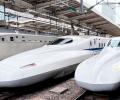
Railway Minister Ashwini Vaishnaw will inaugurate the underground tunnel-boring work from Vikhroli to the Bandra Kurla Complex station in Mumbai on Sunday, marking the maiden use of a tunnel boring machine for the country's first bullet train project, between Mumbai and Ahmedabad.

With East Asian countries remaining locked in a tussle over mineral-rich South China Sea, India today said the dispute should not override the interests of the region and favoured an "open, inclusive and rule-based" architecture to govern the maritime region

Amid the dispute between India and China over exploration in South China Sea, the United States on Tuesday said the laws of the seas should apply and issues should be addressed through dialogue.

Beijing has been wary of Sanae Takaichi's efforts to boost Japan's military profile since taking office six months ago, points out Dr Rajaram Panda.

India has refuted claims of payment issues hindering crude oil imports from Iran, clarifying that refiners have the flexibility to source oil from various global suppliers. The Ministry of Petroleum and Natural Gas addressed reports of a tanker rerouting to China, emphasising standard industry practices and secured oil requirements.

Since 55 per cent of Indian trade passes through the South China Sea, and with over $5 billion investments in the energy sector in Vietnam, it is imperative India actively pursues its national interests in the region, says Srikanth Kondapalli.

An international tribunal in the Hague has ruled in favour of the Philippines.

Poland's Secretary of State, Wladyslaw T Bartoszewski, has credited Prime Minister Narendra Modi with preventing Russian President Vladimir Putin from using tactical nuclear weapons in Ukraine in late 2022, highlighting Modi's significant influence on the Russian leader.

The United States has temporarily lifted sanctions on the sale of Iranian oil already in transit to ease soaring global crude prices, making 140 million barrels available to the market.

Much will depend on how the protagonists use the current interlude to work proactively for the beginning of a durable settlement or, on the contrary, prepare for a new round of escalation, points out Ambassador M K Bhadrakumar.
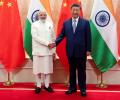
'China's basic purpose of taking the Shaksgam Valley was access to the Indian Ocean.'

India and Japan on Friday sought a peaceful solution to the territorial disputes in the strategic South China Sea, saying parties involved in the matter must not resort to "threat or use of force", in remarks that could anger China which is opposed to any outside interference.

United States President Donald Trump has said that Iran is under close watch and a 'massive fleet' is heading towards the Gulf region.

Successful interceptor, anti-ship, MIRV and hypersonic technology tests have strengthened India's position among a select group of advanced missile powers.

It is an unusual choice to depute a retired general for the funeral of a revered religious figure but a thoughtful one in an attempt to inject verve into the bilateral relationship and restore the equilibrium in India's West Asian policies, notes Ambassador M K Bhadrakumar.

Any move by India to join the US navy for jointly patrolling the disputed South China Sea will be against its national interest, would divide Asian countries and further escalate regional tensions, a state-run Chinese daily said on Friday.

Donald Trump expressed optimism about securing an agreement with Tehran to prolong a truce and restore transit through a strategic maritime chokepoint within the next week, even as he criticised political opponents and the media for what he described as their tendency to distort outcomes, even in a hypothetical scenario of complete Iranian military surrender.
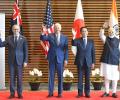
Chinese and Russian warplanes on Tuesday conducted joint air patrols over the Sea of Japan, the East China Sea and the West Pacific Ocean as the leaders of Quad held their in-person summit in Tokyo, in an apparent attempt to send a message of unity between Beijing and Moscow.
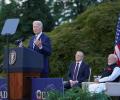
United States President Joe Biden was caught on a hot mic telling leaders of the Quad nations that China was testing them, thus reflecting upon the American seriousness of the emerging Chinese threat.
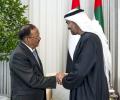
India is the only significant power that all parties trust, or at least do not distrust, notes former defence secretary Ajay Kumar.

There are enough people at the top decision-making level in Tehran who are still willing to negotiate, provided Trump can create the right setting for the negotiation to acquire a dynamic of its own, points out Ambassador M K Bhadrakumar.
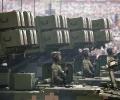
In its annual report to Congress on Tuesday on 'Military and Security Developments Involving the People's Republic of China 2025', the US Department of War said the People's Liberation Army (PLA) is actively considering and planning for additional military facilities.

A lesson for India is to clearly define objectives beforehand, so that the adversary or other parties do not attempt to mitigate them midway.
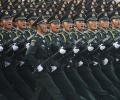
It will be a historic and strategic mistake to insist on taking China as a threat and adversary, or even an enemy, Chinese Defence Minister General Wei Fengh said on Sunday as he underlined that the China-United States relationship is at a critical and crucial juncture.
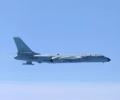
As Prime Minister Narendra Damodardas Modi, United States President Joe Biden, Japanese Prime Minister Kishida Fumio and Australian Prime Minister Anthony Albanese met at the Kantei palace in Tokyo on Tuesday, May 24, 2022, to give the Quad a boost, Chinese and Russian warplanes on Tuesday conducted joint air patrols over the Sea of Japan, the East China Sea and the West Pacific Ocean.

Historically, India was a major buyer of Iranian crude, importing significant volumes of Iranian light and heavy grades due to strong refinery compatibility and favourable commercial terms.
The official told the reporters during a conference call on Friday, ahead of the next week's 2+2 India-US Ministerial in New Delhi, that the Trump administration was providing support to India through defence sales, joint military exercises and information sharing.
'We will stand with friends, partners and allies to advance our shared prosperity, security and values in the Indo-Pacific region'
The Quad grouping has called for bringing the perpetrators, organisers and financiers of the Pahalgam terror attack to justice without any delay and urged UN member nations to extend cooperation for it.

The Kremlin has announced it will not disclose data on crude oil exports to India, citing concerns about 'ill-wishers'. This decision follows reports of increased Russian oil supplies to India and China amid geopolitical tensions.

The intriguing bit is that Trump is likely to attend the talks in Islamabad this weekend -- if he does, it will be the clearest signal yet that the US is ready to exit the war with some sort of win to show, since he cannot afford to go for the talks and return empty-handed, notes Prem Panicker in his must read blog on the Iran War

The 'rescue' operation occurred within kilometres of Iran's underground tunnel complex at Isfahan, assessed by the IAEA and US intelligence as holding a substantial portion of the country's 60 per cent enriched uranium stockpile. Retired senior US military officers have highlighted that the mission's footprint -- hundreds of special operators, multiple heavy-lift aircraft deep inside Iran -- appears outsized for recovering a single airman. Prem Panicker continues his must read blog on the Iran War.

China is engaged in hotly contested territorial disputes in the South and East China Seas. Beijing has also made substantial progress in militarising its man-made islands in the past few years, which it says it has the right to defend.
If they act now, they can reshape the strategic map of Asia without firing a shot. If they wait, the next opportunity will come only after a serious Taiwan Strait incident -- by which time the price will be far higher, and the room for boldness far smaller -- the opportunity may well be lost by then. The question is no longer whether this can or should be done, points out Varun Arya.

The Quad also vowed to work towards a free, open and prosperous Indo-Pacific, a region that has seen increasing Chinese military muscle-flexing in the last few years.

India has expressed strong concern over the targeting of commercial shipping in the Strait of Hormuz during the West Asia conflict, urging for the restoration of unimpeded navigation and global commerce.
Blinken also underlined that diplomacy is the only way to definitively end the Russian conflict in Ukraine.

The Indian and Chinese troops have been locked in a tense border standoff in eastern Ladakh since May 5, 2020, when a violent clash between the two sides erupted in the Pangong lake area.

US Energy Secretary Chris Wright said that long-term oil supplies are 'abundant' and there are no worries regarding that, but in the short term, there is a need to get oil on the market.
